
Read Carroll County Deed Records
The Carroll County Recorder is the office of record for instruments affecting real estate title. Deeds arrive alongside mortgages, releases, liens, easements and plats. A deed names the parties, describes the parcel, and conveys an interest in the land. A mortgage or lien works differently. It records an encumbrance, not a change in the owner of record.
| Deed Type | What It Does | Common Use |
|---|---|---|
| Warranty deed | Conveys the grantor's interest with stated title promises | Ordinary arm's-length transfer |
| Quitclaim deed | Conveys whatever interest the grantor possesses without broad warranties | Family, estate or title-cleanup transfer |
| Trustee or executor deed | Transfers property through a trust or estate representative | Trust administration or probate |
| Sheriff or tax deed | Documents a transfer following the applicable sale process | Foreclosure or delinquent-tax matter |
| Plat or easement | Records lots, dedications, access or another land interest | Subdivision and right-of-way research |
Labels alone settle a document's legal effect. Read the whole instrument and match its legal description against the parcel in question. Check too for later releases or corrective filings. The Recorder, never the image vendor, supplies the official or certified copy.
Doxpop Starts in January 1994
For modern conveyances, the Doxpop Indiana recorded-document index is Carroll County's web route for deed records. Its county coverage table reports index entries and scanned images beginning in January 1994. The index updates nearly in real time. Images follow daily. Doxpop also cautions users that its display is not the official record.
Search names exactly as indexed. Try variants for trusts, estates, companies and changed surnames. Rely on party names and recording dates first. The search form does not center on parcel numbers or legal descriptions. Book/page and instrument references in the results then lead to the full document.
Note: A no-hit result before 1994 usually reflects a change in access channels, not proof that no deed exists.
Walk Carroll County's Grantor-Grantee Chain
A grantor-grantee index ties transfers together by party name. Start with the current owner. That person or entity appears as grantee on the acquisition deed; find it, then use the legal description, not the street address, as the continuity check across each transfer.
- Find the current owner's acquisition deed, with that owner indexed as grantee.
- Copy the grantor, recording date, reference and complete legal description.
- Search that grantor as an earlier grantee, then compare the land description and acreage.
- Repeat until January 1994, then continue through the Recorder's books or State Library microfilm.
- Grantor
- The party conveying an interest.
- Grantee
- The party receiving that interest.
- Chain of title
- The connected sequence of instruments affecting the same land.
- Book/page or instrument number
- The recorder reference used to retrieve a particular filing.
Carroll's Paper Trail Reaches to 1828
Online deed records cover only Carroll County's modern era. The Indiana State Library microfilm finding aid lists deed books and grantor/grantee indexes beginning in 1828, the year the county was organized, along with older mortgage material. The workflow splits in two. Doxpop serves 1994 forward. Deed books and microfilm cover everything earlier.
Keep the description details. For an old town parcel, that means subdivision, addition, lot and block; for rural land, section, acreage, township/range or metes-and-bounds wording. Nineteenth-century books use no state parcel key. The State Library's Carroll County guide points to companion probate, court and land holdings.
Recorder Fees and Copy Choices
The Recorder's published 2021 schedule separates recording charges from copy charges. Deeds and most other instruments cost $25. Mortgages, subordinate mortgages and re-recorded mortgages run $55. Copies through 11 by 17 inches are $1 per page, with larger copies at $5 per page. Certification adds $5, and extra oversize pages and multiple cross-references carry separate charges.
Those charges shape the access choice. Use an index entry or image for preliminary digging. Request a plain copy when the text itself matters. Certification is for when an official copy is required. Credit or debit payment carries the processor's convenience fee, so confirm the current amount with the office before mailing payment.
3,341 Filings in One Recorder Year
The Recorder reported 3,341 recorded documents during 2024, returning $47,023 in recording fees to the county general fund. More than 72,500 older documents were backloaded into the office's software. Volume like that punishes a broad scan. Date limits and party-name variants matter more.
Electronic submission and public retrieval are separate processes. E-recordings arrive through named vendors. Public confirmation still runs through Doxpop and the Recorder. A newly submitted instrument is not recorded until it appears there and the office can verify it.
Watch New Carroll County Filings
The Recorder promotes Doxpop Property Watch, a free email-notification service for new filings matching registered criteria. An alert is a tip. It flags a possible deed or lien. It is not a fraud finding. Nor does it interpret the document. The Property Watch signup page shows the online starting point for Carroll County alerts.
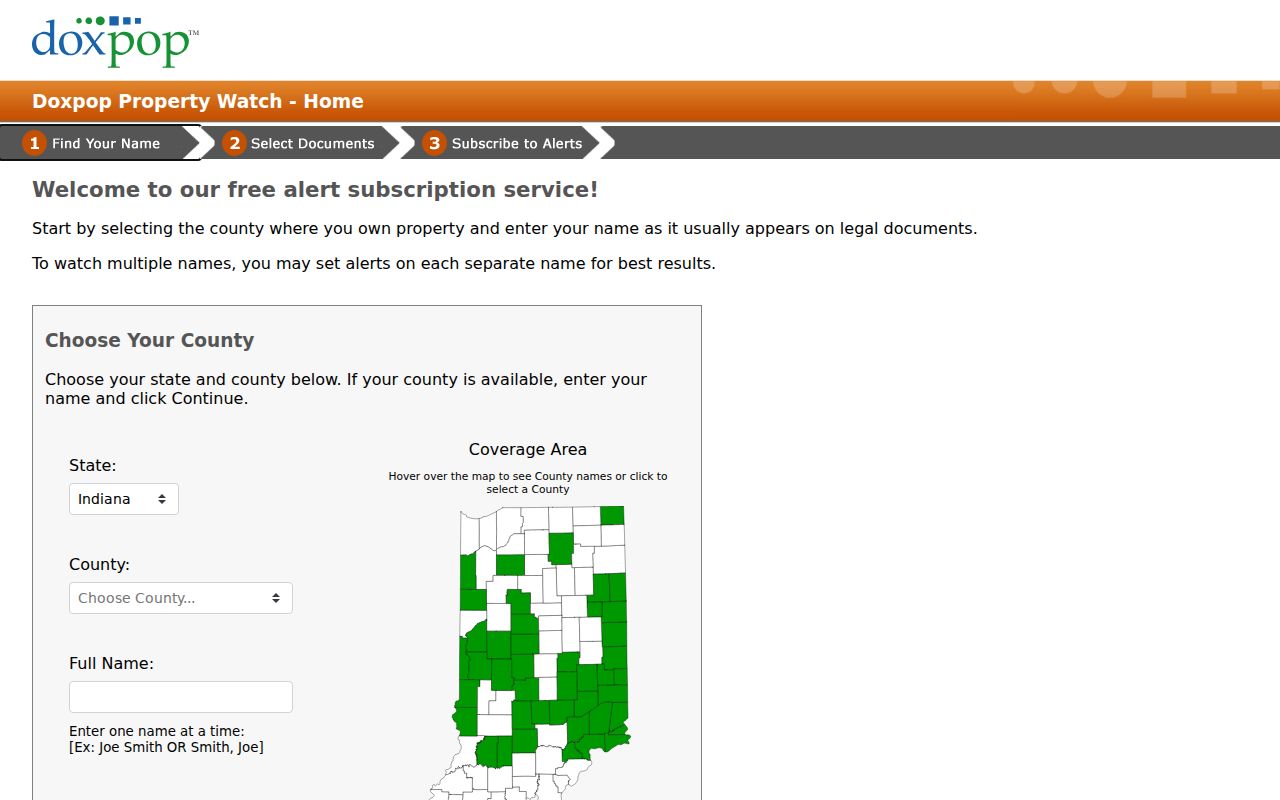
Let the notification prompt real verification. Retrieve the indexed instrument itself. If an alert is unfamiliar, contact the Recorder at (765) 564-2124. Compare the grantor, grantee, legal description and signatures. Do not react to the label alone. Suspected crime goes to local law enforcement after the record is verified.
Get a Carroll County Deed Copy
Doxpop carries the modern deed index. It also includes any images the county has made available, so start there for a quick copy. If the image you need is missing, the Recorder's office handles requests in person. The address is 101 W Main Street, Suite 205, Delphi, Indiana 46923. The office opens at 8 a.m. Monday, Tuesday, Thursday, and Friday. It closes at 5 p.m., with the last recording accepted at 4 p.m. Wednesday is a short day. Hours run 8 a.m. to noon, and recording stops at 11 a.m. A quick call to (765) 564-2124 can save you a wasted drive. An email to ccrecorder@carrollcountyin.gov works just as well.
Mail works well when an online image is unavailable and a trip to Delphi is not practical. Include the names on the deed and an approximate date. Add the legal description and the book/page or instrument number if you have it. Ask the office to confirm the cost and payment method before you mail anything. Indiana's Access to Public Records Act offers a request route for public records not otherwise available. It is subject to statutory exclusions and the Recorder's own copy rules.
Recorded, not guaranteed. Carroll County deed records show filed instruments, not an attorney's title opinion; unrecorded interests and later instruments may affect the conclusion.